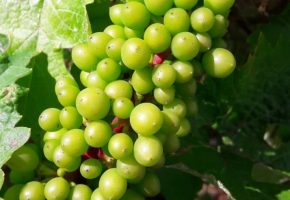
It seems pertinent, having moved to a small village that falls within the geographical boundaries of the Vouvray appellation, to have a more detailed look at this famous white wine appellation from the Loire valley.
Vouvray was one of the first wines in the Loire valley to be officially recognised and given an AOC (Appellation d’Origine Controlée) in 1936.
Exclusively from the Chenin Blanc grape (well I say exclusively actually a maximum of 5% Orbois is also permitted in the blend), Vouvray wines can be dry, off-dry, sweet or sparkling (around 60% of total production). The surface area of the Vouvray still wine appellation is around 1000 hectares with around 200 producers (192 according to 2005 stats). There are 186 growers that make their own wine, one co-operative and 4 négociants. For Vouvray Mousseux (the sparkling wines), the surface area is 1,165 hectares with 180 growers and 178 wine producers, 1 co-operative and 7 négociants. A teensy bit of Vouvray (1 hectare) is made in a pétillant style (lower in atmospheric pressure than mousseux so with a more gentle fizz).
The area of production for Vouvray extends across 8 communes: Chançay, Noizay (our village), Rochecorbon, Vouvray, Parçay Meslay, Tours, Reugny, Vernou sur Brenne. Vineyards are planted on limestone hillsides that have flinty clay or sandy clay top soils. Vines must be planted with a density of 6000 vines per hectare minimum, there must be 1.6m maximum between the rows and 0.9 between the vines within a row. Maximum yield for still wines is 52hl/ha and for sparkling wines 65hl/ha. Sparkling wines are made in the traditional method with the second fermentation in bottle and a minimum of 9 months ageing on the lees (yeast deposit).

Vouvrays from Peter Hahn
Vouvray is an appellation that is well known outside of France and the wines are extremely food friendly. The off-dry styles are particularly good with spicy food and the sparkling Vouvray, a perfect aperitif. Of the many growers making wine in the appellation, some are making wines that are infinitely better than others. Growers we can highly recommend are: Peter Hahn of Clos de la Meslerie, Mathieu Cosme, Bernard Fouquet, Vincent Carême, Domaine Huet, François Pinon and Philippe Foreau.
Many of the top growers in the Vouvray appellation are choosing to work their top parcels using horses. It’s labour intensive but is beautiful to see and really brings them closer to the terroir. We’ve introduced a new tour this season called Going back in time for the future of Loire Wine that includes a visit to see how these lovely animals work the vineyards.
source www.inao.gouv.fr
LegiFrance.gouv.fr (cahier des charges)