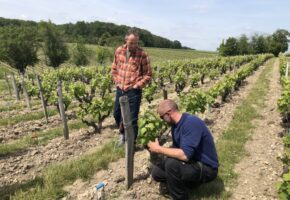
Anjou, the winemaking region around Angers and stretching as far east as Saumur, has been famous for its Chenin Blanc wines since the 9th Century. There are many appellations that fall under the Anjou umbrella (the classy dry whites of Savennières, the sweet wines of the Coteaux du Layon, Bonnezeaux and Quarts de Chaume) but today I want to focus on the dry white wines that are sold under the Appellation Anjou Blanc. These wines are often over looked and yet offer some of the most interesting and complex whites of the region. They also offer excellent value for money.

Chenin Blanc grapes
White wines from Anjou must come primarily from the Chenin Blanc grape (sometimes called the Pineau de la Loire) and may also have up to 20% of what the French authorities call ‘accessory varieties’, Sauvignon Blanc and Chardonnay. Vineyards must be planted with a minimum density of 4,000 vines per hectare (2.47 acres), the rows more than 2.5 metres apart and the vines less than 1 metre apart. In reality, most quality Anjou Blanc is made from 100% Chenin Blanc.
Vineyards that are slightly less densely planted may also be permitted to produce an Anjou Blanc as long as the canopy is sufficiently high to ensure adequate photosynthesis to enable proper maturation of the grapes (the height of the trained foliage must be at least equal to 0,6 times the space between the rows). There must be no more than 20% of vines missing in any single vineyard and irrigation is forbidden.
The earliest date of harvest is controlled by the local authorities and grapes must be picked ripe and have a minimum potential alcohol of 11% (187g sugar per litre – it takes 17g of sugar per litre to create one per cent of alcohol).
Wines sold under the Anjou Blanc Appellation must have less than 3g residual sugar in the finished wine (although this can increase to a maximum of 8g per litre under certain conditions if the total acidity is particularly high.

The Tuffeau limestone that gives Anjou Blanc or White Anjou its name

The slate that gives Anjou Noir or Black Anjou its name
Dry whites from Anjou can have very different expressions. Anjou has two very distinctive terroirs. In the west, the high presence of schist and slate led to this part of Anjou being referred to as Black Anjou or Anjou Noir which forms part of the ‘Massif Amoricain’ while the eastern part of Anjou became known as Anjou blanc or white Anjou due to its predominantly limestone soils (here known as Tuffeau). Happily, the Chenin Blanc grapes loves both these terroirs and performs exceptionally well on both. Rainfall can be low in Anjou and the climate is generally oceanic, moderated by its relative closeness to the Atlantic.
So what can you expect in the glass? Anjou Blanc that has been fermented in stainless steel and has not spent any time in oak has a wonderful floral citrussy, character with notes of lime flower and a kind of pithy, plum skin quality. Fresh on the palate they have lovely acidity and are perfect drunk as an aperitif or alongside simply cooked fish. Anjou Blanc that has been fermented and aged in oak generally has more weight on the palate. A grapefruity character is very common on wines that have come from the slate soils and these are more earthy, with floral aromas and stone fruit character. These pair extremely well with fish served with a creamy sauce, mushroom risotto and earthy patés.
Here is how you pronounce Anjou Blanc and Anjou Noir in French.
Producers to watch out for who are making excellent dry Anjou Blanc are: Domaine Ogereau, Patrick Baudouin, Domaine de la Bergerie, Chateau de Breuil, Domaine de Bablut, Chateau de Fesles, Domane Vincendeau, Chateau de Bois Brinçon, Domaine Richou, Domaine des Rochelles and Domaine Leduc Frouin.