As you head east from Saumur on the north side of the river Loire there is little trace of vines. In fact, there are no vines on the north side of the river between Angers and Saumur. This land is part of the ancient flood plain, wonderful for growing all manner of crops, fruits and vegetables but not suitable for vineyards.
As you enter the small village of St Nicolas de Bourgueil, everything changes. Not only will you see the sandy soils that lead down to the river, large plantings of asparagus and hemp, but also vines come back into the picture and shortly after, the landscape is once again totally dominated by vineyards. The St Nicolas appellation spreads over a former river terrace extending down to the Loire and the foot of the hillside to which it is attached. South facing and largely open, it is protected by the large forest to the north.

St Nicolas de Bourgueil
St Nicolas de Bourgueil has the reputation for producing lighter style wines than its neighbour Bourgueil and this is because a large majority of its vineyards are on the lower areas, closer to the river Loire where there is no limestone bedrock and the soils are predominantly alluvial with sand and gravel. There are however, vineyards that are planted on the slopes leading up to the forest behind. Here you find soils with more clay, flint and the limestone bedrock that is so suited to making Cabernet Francs with structure and elegance. So, its actually a question of where the vineyards are located and the individual terroir. There are around 1,000 hectares planted.

The winery of one of our favourite organic producers, Domaine de la Cotelleraie
We are big fans of St Nicolas wines. They are beautifully fruity and elegant and have a lovely weight that makes them extremely drinkable. Young entry level cuvées are bursting with juicy raspberry fruit and wines coming from more complex parcels are more structured, may have spent some time in oak yet remain fresh and ‘digest’ (a French word that perfectly describes wines that are wonderful with food). These are not heavy, robust wines that you’ll tire of after a glass, they are luscious, fresh and beautifully easy to drink.

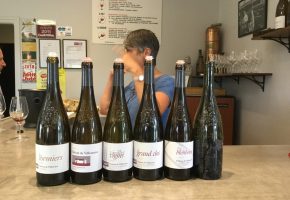
Tasting with another great organic producer, Frederic Mabileau
There is no white wine permitted in the appellation, just a little rosé and red. All wines must be picked, vinified and aged within the defined geographical zone which extends beyond the actual village of St Nicolas de Bourgueil. Cabernet Franc is the principal grape although a small amount of Cabernet Sauvignon (max 10%) is allowed under current legislation. Most of the growers with which we work only use Cabernet Franc 100%. There are around 80 or so growers working in the appellation and only about 8 or 9 of them work organically.
Vines must be pruned before the 1st May and growers are only permitted to have a maximum 20% of dead or missing vines in their vineyards. The space between the vines and rows as well as the method of training the foliage is strictly controlled. Grapes must be destemmed before fermentation (for the elaboration of red wines) unless they are destined for a carbonic maceration (a different form of fermentation that used whole bunches of grapes, commonly used in the Beaujolais region for the production of fruity reds).
In the past most vine growers in this area also had other crops such as apples, pears, shallots or asparagus. This is no longer the case with the current generation of growers realising the potential of their vineyards and deciding to concentrate on the production of fine quality wine.
Some growers that we can highly recommend are Domaine de la Cotelleraie, Frederic Mabileau, Sebastien David, Yannick Amirault