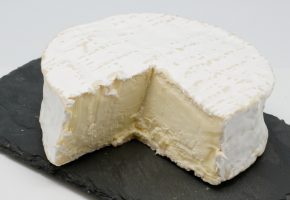
One of the most famous French cheeses and one that many of you will be familiar with, Camembert is a moist, soft cheese with a velvety rind and a slightly grainy to almost runny texture.
Marie Harel (born Marie Catherine Fontaine in 1761) is credited with the invention of Camembert in 1791. Legend has is that she created the famous recipe while working as a cheesemaker at the Manor of Beaumoncel with the help of local priest Abbott Charles-Jean Bonvoust. Apparently there is little evidence to back up this story but she did instigate the beginning of large scale production of Camembert and her family (notably her grandson who created a cheese factory in the commune of Mesnil-Mauger) carried on the tradition of cheesemaking.
This is how you pronounce it:
The first Camemberts were made using unpasteurised milk (as indeed many French cheeses are today), and Camembert de Normandie, which accounts for around 10% of total production, must be made from unpasteurised milk. Camembert de Normandie was granted a PDO (protected designation of origin) in 1992 and can only use milk from Normandy cows. Factory made varieties are often made with pasteurised milk and tend to have a thicker velvety rind whereas artisanal Camemberts have a thinner white crust that can have slightly pinkish blotches.
Only Camembert de Normandie has the AOP (PDO) so if you are looking for the real thing then be sure to check the labelling. Cheeses marked ‘fabriqué en Normandie’ are not subjected to the same stringent rules of production.
Every cow that produces milk for Camembert de Normandie must have a minimum of 0,33 hectares of grass to graze upon and they must be in open pasture for a minimum of 6 months per year. The milk must be raw, can’t be heated to more than 40°C and can’t be ultra-filtered or micro-filtered. There can be a maximum of 72 hours between milking and the beginning of maturation.
The result is a beautiful soft, moist cheese that has delicate aromas of mushrooms and hay. You can enjoy it young and still chalky in the middle or slightly older when it becomes more creamy and runny. Typically it’s sold in small wooden boxes that are made of poplar. These were introduced by the French engineer Ridel at the end of the 19th century and allowed this famous cheese to be transported all over the world.
As Camembert is in the shape of a cake, you cut it like a cake.
Here’s a little video (in French) showing the production of Camembert