The appearance of a wine. There is a lot you can gather from just looking at a wine. Tip the glass at an angle of 45°C preferably against a white background and take a look. What can you see?
White wines are often very pale in colour, sometimes nearly water white. Sometimes they have a richer colour, a golden, straw appearance. What can that tell you? Well, wines that are very pale are unlikely to have spent any time in oak. Young wines tend to be paler than older wines and drier wines tend to be paler than sweeter wines. A rich golden colour is a good indicator that the wine has spent time in oak (and probably new oak). Think of Pinot Grigio as a good example of a pale wine and a New World Chardonnay as a good example of a richer wine. Dessert style wines can be very dark in colour. Made from very late picked grapes the juice can be already amber before the fermentation even starts.

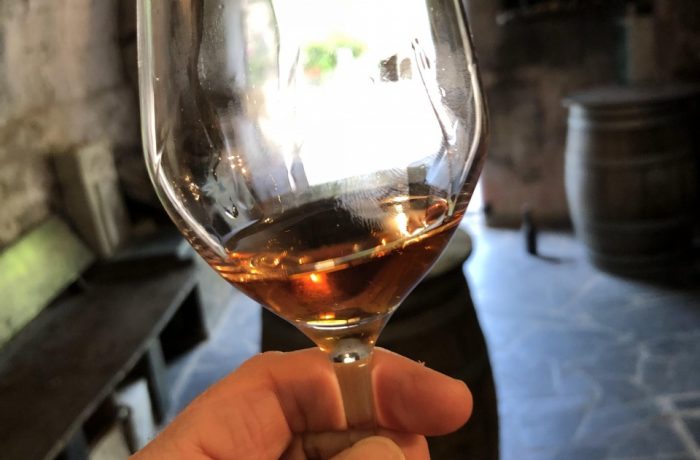
An Coteaux du Layon from 1976 from Leduc Frouin. Golden in the glass but still fresh and clean.
Red wines tend to be more purple and pink in colour when young and change to ruby and garnet colours with age. Very old red wines often go a brick red or even tawny colour (think Tawny port). Different grape varieties appear different too. Nebbiolo and Pinot Noir are less intense in colour whereas you can barely see through a young inky Cabernet Sauvignon or Syrah.
Are there bubbles in the wine? This can be an indication of wine style (think Muscadet or Vinho Verde) or of recent bottling. It can also be a danger sign – is the wine supposed to have bubbles? Or is it a sparkling wine in which case you would be worried if there were no visible bubbles!

Definitely not clear and bright but not faulty. A red wine that has not been filtered will often have a slight deposit that makes the final glass of the bottle a little cloudy.
Take a look at the clarity of the wine. Is it crystal bright? Not all wines are finely filtered before bottling these days so it’s possible to have a wine that is just a teensy bit hazy. Maybe it’s a ‘natural’ wine that has been made with no intervention in the winery. Or maybe it shouldn’t be hazy and is faulty? Red wines are more likely to be slightly hazy than white wines.

A rosé wine that is clear and bright. No haziness here.
Observe the way the wine falls away from the glass in ‘legs’ or ‘tears’ but don’t draw conclusions from this. Often mistaught even in professional circles, the ‘legs’ of the wine are not an indication of either the quality or sweetness of the wine. This is what we call the Marangoni effect, the relationship between the alcoholic content of the wine, the shape of the glass, surface tension and evaporation. Have a look at this video here that explains it in more detail.